Claude Frontier Academy and the hard part of production AI
Anthropic's Frontier Academy plan points to a production skill gap: ownership, recovery, security and evidence matter after the demo.
TL;DR
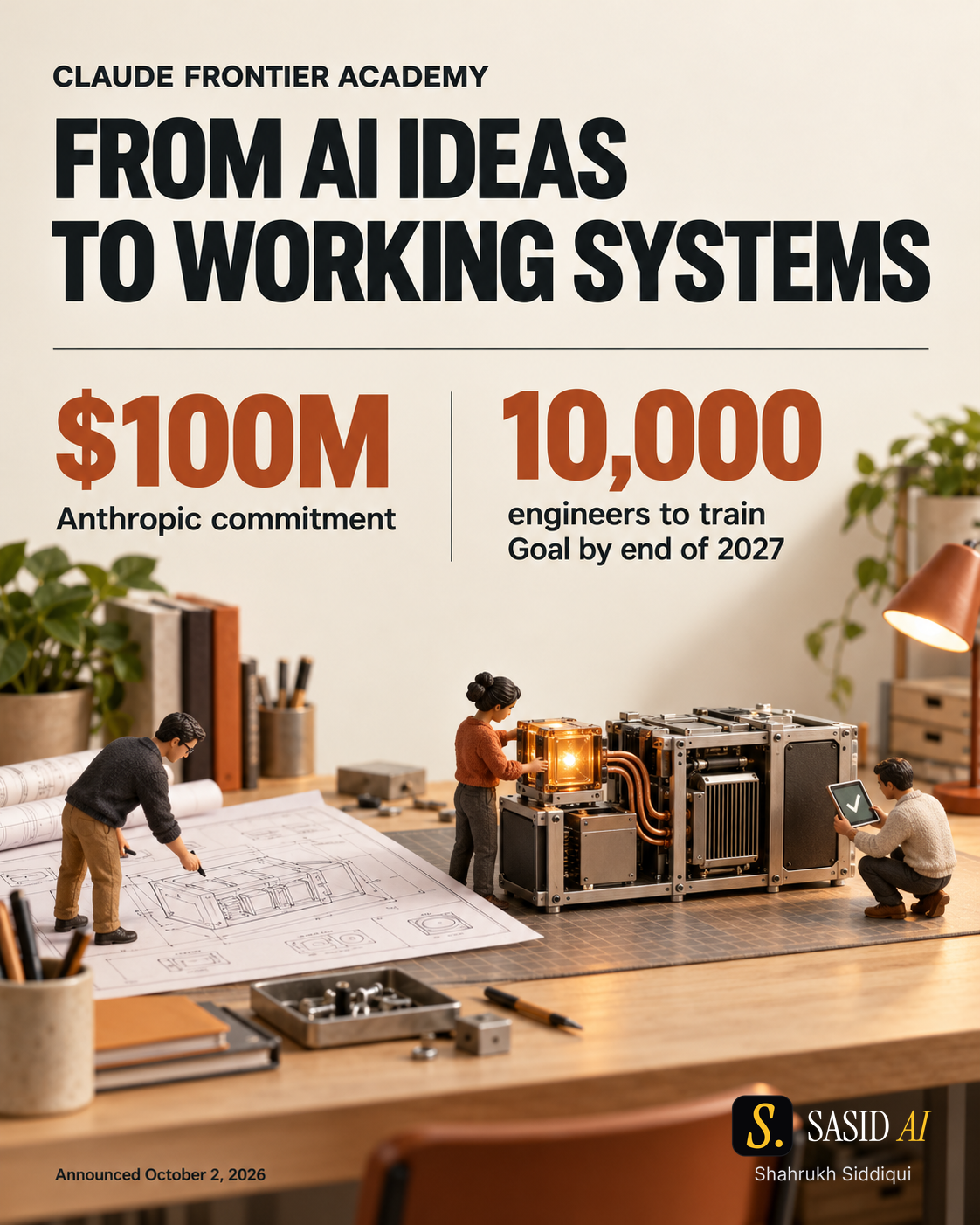
- Anthropic announced Claude Frontier Academy on October 2, 2026, with a $100 million commitment and a goal of training 10,000 Frontier Deployed Engineers by the end of 2027.
- The announcement focuses attention on deployment work, security review and practical assessments.
- Production AI needs explicit ownership, safe changes, recovery paths and evidence that a result is better.
- The training target is a goal, not completed training or customer proof.
The headline from Anthropic's Claude Frontier Academy announcement is large: a $100 million commitment and a goal of training 10,000 Frontier Deployed Engineers by the end of 2027. The part that stayed with me was the implied job description. Useful AI systems need people who can move from a promising model to a working system with limits, checks and recovery.
That is the gap between an interesting answer and production work. A model can draft a plan. A team still has to decide what it may change, when it must ask for help, how it recovers and what evidence proves the result.
Production starts with a boundary
My simplest rule in Throughline is that AI can suggest changes, but it must not overwrite fields the user has set. The rule is small, but it gives the system a clear ownership boundary. A user-owned value stays authoritative. An AI suggestion remains a suggestion until the person accepts it.
The same pattern works for an agent task. Before the first call, write down:
- the fields or files the agent may change;
- the actions that need approval;
- the data it may read;
- the checks that define an acceptable result;
- the person who can resolve an unknown.
This makes a later handoff possible. Another model can continue from the task contract without guessing which decisions were already approved. A route change also becomes explicit. The new provider receives the same boundary and the same acceptance check.
Recovery is part of the feature
Production work will hit timeouts, missing credentials, stale instructions, provider limits and partial outputs. A good workflow keeps those states visible. It does not turn a timeout into a success because the next model might finish the job.
In Agent, I am designing the evaluation loop so failed attempts, timeouts and unknown results stay visible. That statement describes the product direction and evaluation design. It does not claim a customer result or a measured reduction in failures.
The practical recovery packet is short:
- Record the last verified output.
- Record the failed action and its error class.
- State what remains safe to do.
- Ask for approval before an action with a new risk or scope.
- Re-run the acceptance check after recovery.
This is more useful than replaying the entire conversation. It preserves the part of context that controls the next decision.
Evidence must survive review
An agent saying “done” is a claim. A test, trace, source record or reviewed output is evidence. The evidence needs its own source and freshness. A parent task receipt should not make an unrelated screenshot or artifact look verified.
The production evidence released in Agent follows this rule. Terminal tasks seal the actual output, the checks that ran, time and qualified cost in one receipt. Runs, artifacts and decisions have their own source records. Missing or stale proof is shown as Unverified. The design supports review by a person who did not watch the original model calls.
That is the skill the Academy idea makes visible. The hard work is not only choosing a stronger model. It is building a path where another person can inspect what happened and make a safe next decision.
A useful assessment is a real task
If I were assessing a new production AI engineer, I would give them one bounded task with a real acceptance check. I would ask them to make one correction, hand it to another route, recover from a failed attempt and leave a receipt. I would inspect the assumptions, the approved actions, the test result and the unresolved limits.
The score would not be “the model produced a clever answer.” It would be whether the finished work holds up when the context changes. The target of 10,000 engineers is a stated future goal. The transferable lesson today is to train for the whole system: model, policy, tools, checks, ownership and recovery.
Sources and related reading
The source event is my October 7 LinkedIn post. The Academy visual is conceptual and does not depict the program's facilities or participants.
- Your AI agent says it is done. Is it?
- Why AI coding agents fail on real pull requests
- How Claude Haiku 5.5 subagents fit a lead-worker workflow
- SASID service companion: Claude Frontier Academy and production AI
See the Agent receipt example for a concrete view of output, checks and source status.