AI week, October 2–8, 2026: research, workers and interfaces
Seven dated AI updates from October 2–8, 2026, with practical limits for research, subagents, API credits, interfaces and decision models.
TL;DR
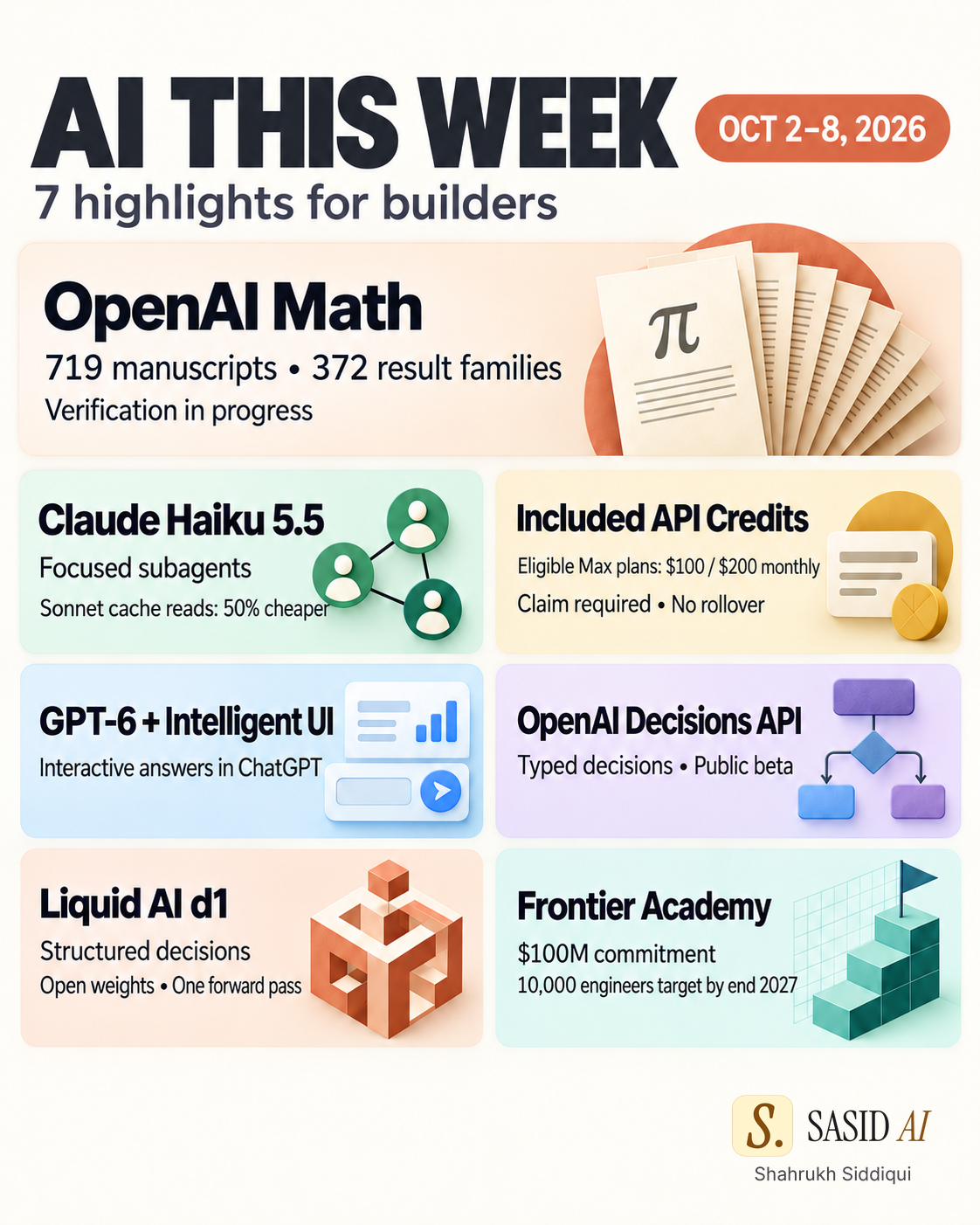
The week of October 2–8, 2026 connected seven ideas: research with artifacts, focused workers, separate API budgets, question-shaped interfaces, typed decisions, open decision models and production skills. The useful thread is evidence. Every new capability needs a boundary, a route and a way to check the result.
Seven updates, with their limits
October 2 — Claude Frontier Academy. Anthropic announced a $100 million commitment and a goal of training 10,000 Frontier Deployed Engineers by the end of 2027. That is a future target, not completed training. The practical lesson is that deployment, security review and recovery need trained owners.
October 6 — OpenAI mathematics. The pinned October 8 openai/math snapshot lists 719 manuscripts across 372 result families. About 42% of top-line results are formalized in Lean, and the history records withdrawals and revisions. Formalization is useful checking evidence, not an independent expert review of every paper or proof that 719 independent open problems were solved.
October 7 — Claude Haiku 5.5. Anthropic positions Haiku 5.5 for focused coding subagents beside Opus 5.5 and Sonnet 5.5. A lead can plan and review while bounded workers inspect files, extract facts or summarize logs. This is a workflow to test. Lower API pricing does not prove lower subscription use or better finished work.
October 7 — included Claude Platform API credits. Eligible Max 5x plans include $100 per month and Max 20x plans include $200. Team credits are pooled. A subscriber may need seven days on an eligible plan and a linked Console organization to claim them. Credits expire at the billing-cycle end, do not roll over, and do not increase interactive Claude Code limits. Eligibility and balance still need an account check.
October 7 — Intelligent UI. OpenAI's announcement describes answers with visuals, buttons, forms, charts and interactive experiences. At Houston Hackathon 2026, I explored a related idea in Tiersel: let the question select a map, trend, ranking or evidence table. Tiersel and OpenAI's UI are separate implementations; Jev chooses views and deterministic code calculates numbers.
OpenAI Decisions API — public beta. OpenAI's public beta guide describes typed decisions from text and images using GPT-6 Luna. A typed choice can make a route or view decision explicit. It still needs an allowed decision set, a fallback and a check on the selected action.
October 7 — Liquid AI d1. Liquid AI released open-weight d1-3B for structured decisions in one forward pass with zero output tokens. Its separate 8 ms RTX 4090 figure is a median of 20 one-question runs with bf16, compilation and CUDA graphs. The atomic.chat Snake video ends at 86 versus 3 on an RTX 3090 in one creator demo. Neither is an end-to-end owner benchmark.
The workflow I would test
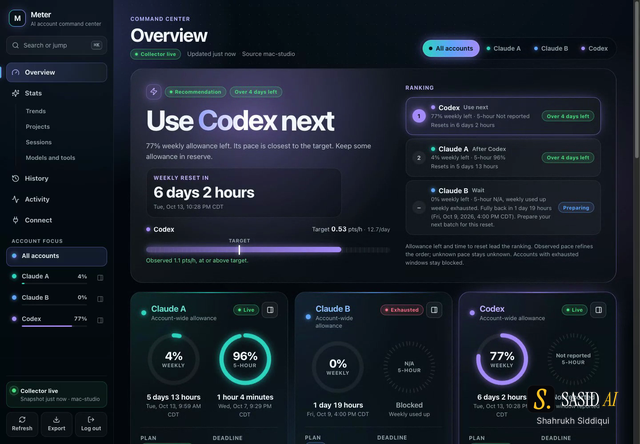
I spend around $600 a month across AI subscriptions and run parallel projects from an M3 Ultra Mac Studio. Meter helps me keep accounts, models and local activity visible. The next experiment is a strong lead, focused workers, decision models for narrow choices and outputs I can inspect.
I would retain the task goal, approved actions, source records and acceptance check across every handoff. I would count retries, review and unknown results. A capability is useful when the finished work holds up after the route changes, not when the announcement sounds impressive.
Sources and related reading
This recap adapts my October 8 LinkedIn post. Read the dated primary sources linked above and the Anthropic Academy announcement, Haiku announcement, credits policy, Liquid AI release and OpenAI math history.
- OpenAI math repository verification
- Claude Haiku 5.5 subagents
- Intelligent UI and the Houston hackathon
- SASID service companion: AI week October 2–8, 2026
For a practical starting point, use the Agent overview and define the check before the first handoff.