Claude vs Codex for a personal AI workflow: choose the route that holds up
A personal Claude-versus-Codex choice, with practical route comparisons that avoid universal benchmark claims.
TL;DR
- I am moving away from my Codex subscription and plan to cancel it.
- In most of my personal tests, Codex was about 2x slower.
- For my workloads, I estimate Claude gives about 5x the overall usage and value.
- These are personal observations and an estimate, not a controlled benchmark or a universal price ratio.
- The right comparison is useful finished work, including limits, retries, review and route changes.
Subscription decisions are easy to make badly. One impressive answer can hide a slow route. One fast answer can hide a review problem. I use several agents and parallel projects, so I care about the useful work I can finish before a limit, how long a result takes and what the monthly cost gives me.
I have had a Codex subscription for a while. I am moving away from it and plan to cancel it because Claude currently fits my personal workflow better. In most of my own tests, Codex was about 2x slower. I estimate that Claude gives me about 5x the overall usage and value for these workloads.
Those numbers need their labels. They come from my own observations. I have not presented these observations as a controlled comparison. The 5x figure is an overall personal value estimate, not a provider claim and not a measured price-per-token ratio. Another developer can get a different result.
Compare the route, not the logo
The route includes more than a model name. It includes the CLI or app, its system context, its tools, its cache behavior, the account allowance and the recovery path when a call fails. A slower wrapper can dominate a faster model. A generous limit can matter more than a small difference in answer quality when the work is iterative.
For a fair personal check, I would keep a small task set and record:
- time to first useful output;
- time to a validated result;
- retries and failed attempts;
- review minutes;
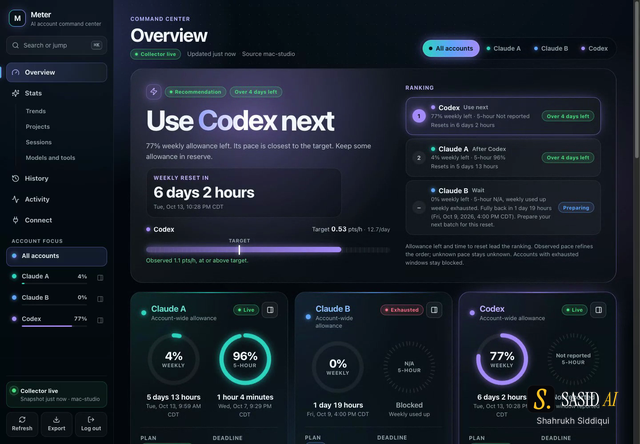
- allowance use and reset timing;
- whether the task survives a provider handoff.
Do not turn a weekly quota into a token benchmark. Do not treat a subscription allowance as an invoice. Do not call a local session count a provider usage report.
Keep context when a task moves
Switching providers becomes expensive when the new agent must rediscover the task. Before a route change, I want a compact handoff:
- the goal and acceptance check;
- the files or records already inspected;
- approved decisions and actions;
- the output that is already verified;
- the open question and the next safe step.
The receiving model can then work from current state instead of a vague transcript. If it needs a different model tier, the change is explicit. If the task needs a person, the question is bounded. If a check fails, the failed attempt remains part of the record.
Agent's receipt workflow is built around that kind of continuity. A task can carry retained context through a provider change and leave output, checks, route, time and qualified cost for review. That is a product capability with evidence behind it; it does not turn my personal subscription estimate into a benchmark.
Included API credits are a separate question
Eligible Claude Max 20x plans include $200 per month in Claude Platform API credits, according to the official Help Center policy. A subscriber may need to link a Claude Console organization. The credits expire at the end of the billing cycle, do not roll over and do not increase interactive Claude or Claude Code limits.
For an eligible account, that benefit can change which experiments are practical, but it does not settle the subscription choice. My eligibility, claim state and remaining balance are account facts I have not turned into a claim here. An API call also needs its own credentials, data boundary, acceptance check and source record.
Reassess when the work changes
I will reassess if the routes change, the limits change or my task mix changes. A tool can be right for architecture review and wrong for high-volume fact extraction. A model can be useful as a lead and wasteful as a worker. The best workflow may use both providers when the handoff is explicit and the result is verified.
The decision is not loyalty. It is a working hypothesis: choose the route that gives this workload more useful completed work, then keep enough evidence to change your mind.
Sources and related reading
The source event is my October 8 LinkedIn post. The post states a personal decision and does not claim that cancellation is complete.
- Claude Code vs Codex CLI: the hidden context tax
- Claude Code vs Codex CLI vs the API: latency and hidden prompts
- How to measure AI subscriptions across accounts and machines
- SASID service companion: Claude vs Codex personal workflow
See the Agent overview if you want to compare a route by its retained task state and reviewable output.