OpenAI's math repository makes verification part of the release
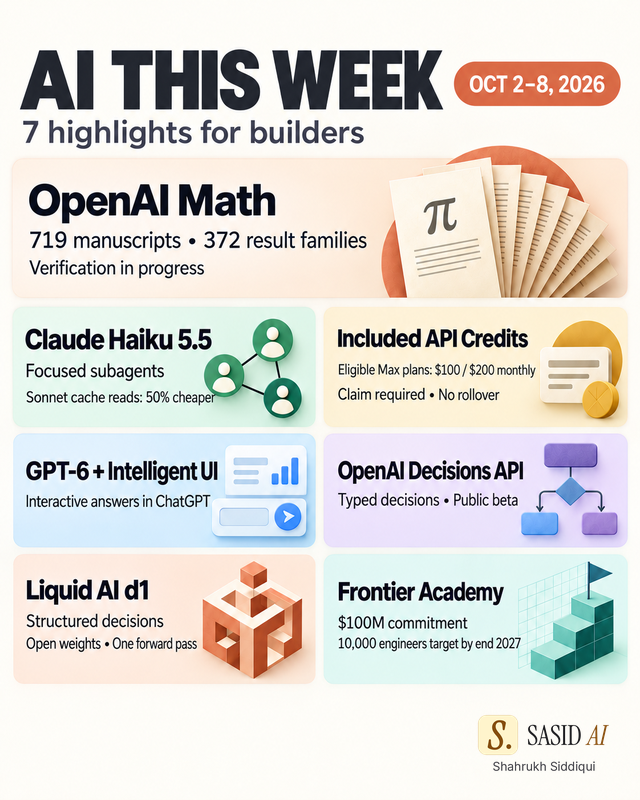
The OpenAI math repository lists 719 manuscripts and 372 result families. Its formalizations, withdrawals and history show how evidence changes.
TL;DR
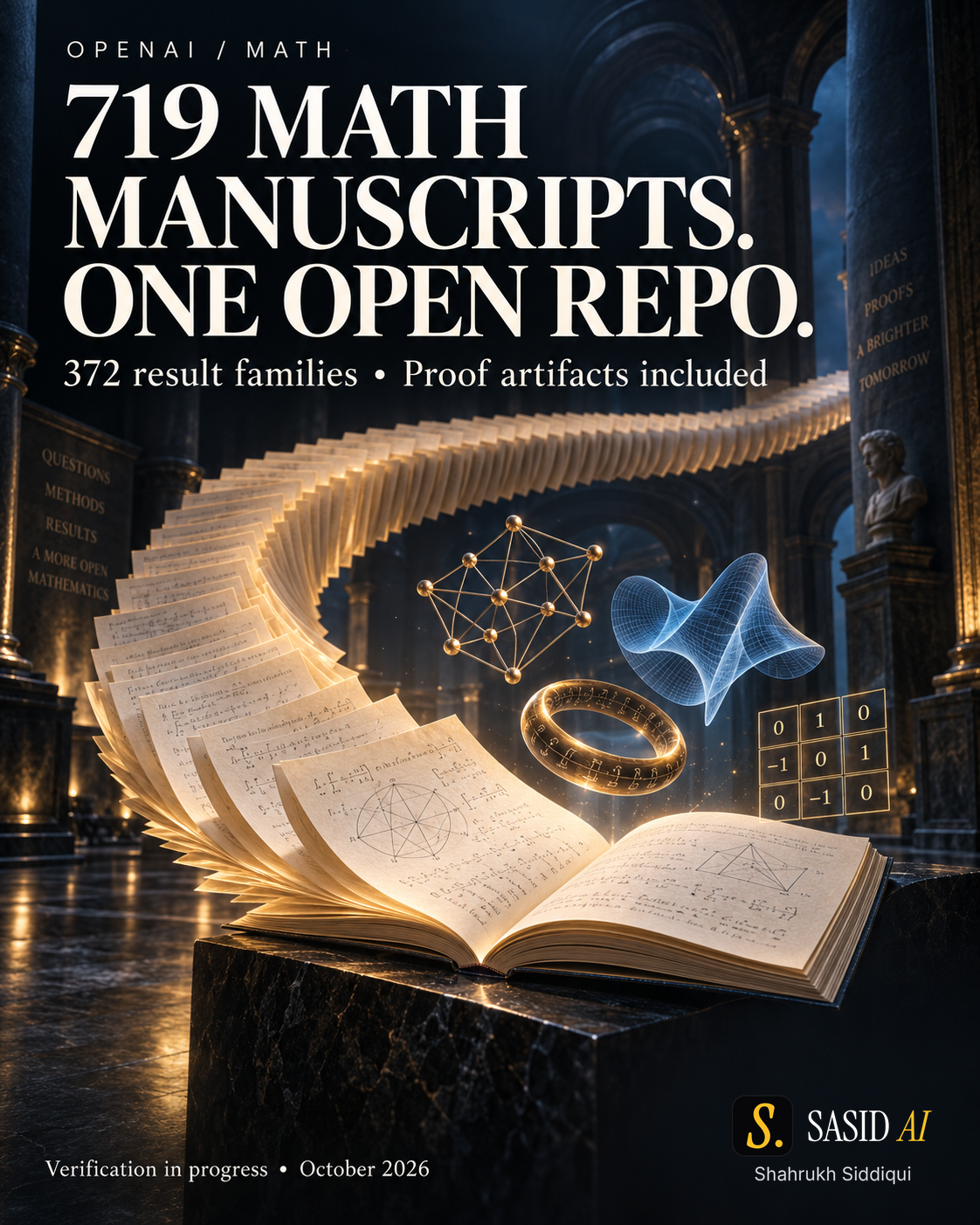
- OpenAI's pinned October 8 math repository snapshot lists 719 manuscripts across 372 result families.
- About 42% of top-line results, 300 of 719, are reported as formalized in Lean.
- Three manuscripts were withdrawn on October 7, 2026, and 14 others were revised.
- Formalization is valuable evidence, but it is not an independent expert review of every paper and the collection does not prove 719 independent open problems were solved.
OpenAI's October 6 release is interesting because it publishes a research collection with a path for checking and correction. The pinned October 8 openai/math snapshot lists 719 manuscripts across 372 result families. The families group related manuscripts, so the top-line counts are not a count of 719 independent open problems.
The repository covers topics that include π, graph coloring and matrix multiplication complexity. OpenAI says the collection came from an unreleased internal frontier model evaluated on roughly 4,000 research problems after existing mathematics evaluations saturated. No named public ChatGPT or Codex model should be substituted for that description.
Verification is a workflow, not a badge
The pinned snapshot reports 300 of 719 top-line results formalized in Lean, about 42%. A Lean formalization lets a computer check a formal proof or statement. It does not mean that an independent expert has reviewed every paper, and a supporting-result comparator does not establish the main theorem of a paper.
That distinction is familiar in software. A passing unit test can check one contract while leaving another assumption untested. A green build can still use the wrong fixture. Evidence narrows uncertainty; it does not erase the need for review.
The useful research artifact therefore includes more than a headline result:
- the paper and its assumptions;
- the formalization or proof code;
- the checks that ran;
- the revision history;
- the unresolved questions and limits.
OpenAI's release also includes ten selected reasoning summaries and compute estimates. A compute equivalent is not elapsed time or a bill. The repository records the difference between an original claim and the evidence attached to it.
Corrections should stay visible
On October 7, the repository history recorded three withdrawals after a sign error and dependent arguments were found. It also recorded 14 other revisions. Those revisions cover mixed changes to proofs, statements, hypotheses, dependencies and citations.
That is not a reason to discard the project. It is a reason to keep the correction path. A result that changes after review should carry its old state, new state and reason. Readers can then ask whether a later proof still depends on a withdrawn claim.
The same rule helps an agent workflow. When an agent changes route, model or source, preserve the previous verified output and record the new evidence. Do not overwrite an unknown with a polished summary. A handoff should tell the next worker which claim is accepted, which claim changed and which check remains open.
From research artifacts to working agents
I run multiple agents and parallel projects across my own apps. What I want from each handoff is something I can verify: a test, a trace, a source record or a clearly stated result. The math repository makes that expectation concrete because a reader can inspect papers, proof code, selected summaries and history together.
Agent's released evidence model applies the same principle to production work. Terminal tasks can seal the actual output, current platform checks, time and qualified cost in one receipt. Runs, artifacts and decisions keep separate source records. If a record is missing or stale, the result remains Unverified. A receipt supports review; it does not make an unsupported claim true.
How I would use the repository
Start with a result family, not the 719 number. Read the statement, inspect the assumptions and open the related formalization. Check the history for withdrawals and revisions. Treat the formalized fraction as coverage, not as a success rate. If you use an agent to summarize a paper, require source pointers and ask it to list what it could not verify.
The best follow-up question is not “Did AI solve mathematics?” It is “Which claims can I inspect, which changed, and what evidence would change my mind?” That question scales from a research repository to a production task.
Sources and related reading
The source event is my October 8 LinkedIn post. The artwork is conceptual and is not an official OpenAI image or a proof certificate.
- Your AI agent says it is done. Is it?
- Why AI coding agents fail on real pull requests
- Claude Frontier Academy and production AI
- SASID service companion: OpenAI math repository verification
Use the Agent receipt example as a production analogue for source-linked, reviewable work.